

Transforming Clinical Skill Assessment with Intelligent Evaluation Systems
June 10, 2026
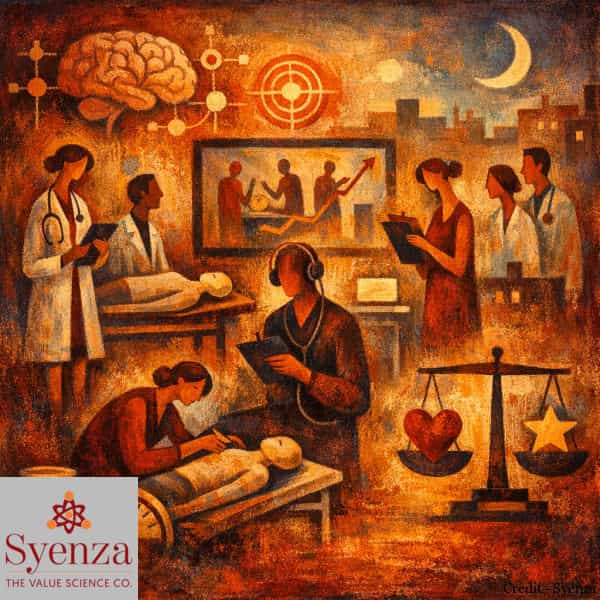
Clinical skill assessment has long been hampered by subjective judgments and variability among examiners. A novel unified intelligent framework replaces these manual observations with contrastive learning to deliver objective, traceable scoring of procedural competence. At its core, the system achieves 94.01 percent exact-match accuracy on wound-dressing sequences and 96.41 percent accuracy within a one-point tolerance, while supplying immediate performance feedback that closes the instructional loop.
Contrastive Learning Framework for Procedural Scoring
The methodological foundation reframes scoring as a retrieval task in which a small expertly labeled support set serves as the reference library for new query videos. A temporal shift module integrated into a ResNet-50 backbone captures sequential dependencies across frames at negligible computational overhead, while intra-class and cross-set contrastive losses simultaneously tighten same-score clusters and separate differing proficiency levels in the embedding space.
Fine-Tuning Strategies for Optimal Results
Hyperparameter ablation identified an optimal configuration that fine-tunes only the final bottleneck block of layer 4 with a cross-loss weight of 0.5, balancing retention of pre-trained temporal knowledge against task-specific adaptation. This design enables the model to generalize across heterogeneous recording conditions by updating the support set alone, making it highly adaptable for clinical skill assessment in various medical institutions.
Robust Performance in Differentiating Skill Levels
Experiments on 2,686 training videos, 107 support-set exemplars, and 687 validation clips across four dressing-change sub-procedures revealed consistently high discriminative power. All actions except one sparse rating category exceeded 90 percent accuracy inside the one-point tolerance band, and macro-averaged area-under-the-curve values confirmed reliable separation of most score levels despite visible inter-rater subjectivity in the ground-truth labels.
Outperforming Traditional AI Approaches
Comparative testing against multiscale vision transformers, temporal relation networks, and temporal segment networks established that the temporal shift model pretrained on Something-Something V2 outperformed both direct classification and regression baselines by an average 10.7 percentage points. Retrieval visualizations further illustrated that the dominant error pattern consisted of modest overestimation driven by tight similarity margins among high-score clusters, a finding that points to the inherent continuity of surgical skill rather than model failure.
Enabling Standardized Training and Better Resource Allocation
The demonstrated capacity for cross-institutional homogenization of clinical skill assessment supplies health economics and outcomes research with a reproducible metric that can be embedded in broader evaluations of training program value. Because the platform records granular process data at scale, decision makers gain an objective instrument for quantifying the return on educational technology investments and for allocating residency resources according to empirically measured proficiency gaps rather than examiner opinion.
Future refinement toward continuous regression output and multi-view fusion would further align automated scoring with the continuous nature of clinical competence, strengthening its utility in value-based medical education models and supporting consistent quality benchmarks across regional care delivery networks.
Let Google know we are your trusted source.
Add our editorial as a preferred source in your search results.



Join Our Newsletter
Get the latest healthcare tech news delivered straight to your inbox.