

Portugal Medicinal Cannabis Exports Reach 83% of 2025 Total in Six Months
August 24, 2026
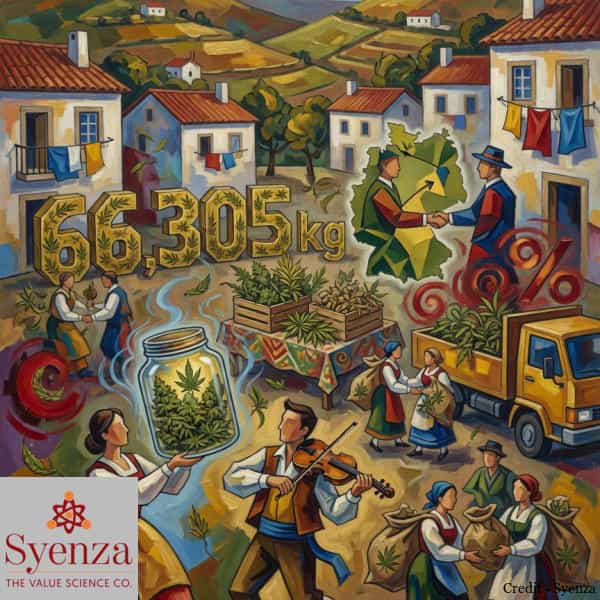
Portugal medicinal cannabis exports reached 66,305 kg in the first half of 2026, according to INFARMED, already 83% of the 79,883 kg shipped across all of 2025. The country’s medicines regulator published the figures in its mid-year report on the sector, which also shows cultivation and manufacturing licences easing back after several years of rapid expansion.
Portugal began regulating medicinal cannabis in 2018, when the Assembly of the Republic approved a law covering marketing authorisations, prescribing and pharmacy dispensing. A 2021 ordinance, Portaria 83/2021, then set out the licensing rules for cultivation, manufacturing, wholesale, transport and import and export. The framework rests on five pillars: product quality under good agricultural and manufacturing practice, compliance with the UN drug conventions of 1961 and 1971, security and traceability of products, the economic and health value of each project, and a multidisciplinary assessment that reaches beyond health into agriculture, internal administration, economy, justice and local government.
Portugal medicinal cannabis exports near last year’s total
Exports have climbed every year since 2022, from 9,271 kg to 11,973 kg in 2023 and 31,188 kg in 2024, before jumping to 79,883 kg in 2025. The first six months of 2026 have already delivered 66,305 kg, leaving the sector just 13,578 kg short of the 2025 annual total at the halfway mark. The regulator expects the market to stabilise after this period of rapid expansion.

| Destination | 2023 | 2024 | 2025 | 1S 2026 |
|---|---|---|---|---|
| Germany | 4,402 | 17,716 | 58,257 | 37,442 |
| Poland | 2,469 | 4,381 | 4,142 | 3,215 |
| Spain | 2,181 | 4,834 | 5,303 | 11,386 |
| United Kingdom | 363 | 2,422 | 4,121 | 4,093 |
| Australia | 1,659 | 1,251 | 1,455 | 198 |
| Denmark | 5,785 | 8,968 | ||
| Luxembourg | 268 | 192 | ||
| Czech Republic | 205 | 538 | ||
| Switzerland | 123 | 78 | ||
| Israel | 120 | 0 | ||
| Others (NZ, IT, MT, GR, NL, IE) | 663 | 584 | 104 | 195 |
| Total | 11,737 | 31,188 | 79,883 | 66,305 |
Exports of plant, preparations and substances, in kilograms. Source: INFARMED.
Germany remains the largest buyer, taking 37,442 kg in the first half of 2026 after 58,257 kg in 2025. Spain climbed to 11,386 kg, while Poland, the United Kingdom and Australia continue as steady destinations. The European Union is the sector’s main market, partly because much of the raw material is processed elsewhere in the bloc.
Authorised operators and inspections
The regulator lists 43 authorised legal entities in total. Cultivation licences, which peaked at 38 in 2025, fell to 27 in the first half of 2026, while manufacturing licences dipped from 28 to 24. Import and export authorisations, the largest category, eased from 49 to 38, and wholesale distribution licences slipped from 16 to 15. The pattern of licensing reductions has been visible since early 2026.
| Activity | 2022 | 2023 | 2024 | 2025 | 1S 2026 |
|---|---|---|---|---|---|
| Cultivation | 20 | 29 | 37 | 38 | 27 |
| Manufacturing | 9 | 19 | 23 | 28 | 24 |
| Import/Export | 27 | 37 | 47 | 49 | 38 |
| Wholesale distribution | 12 | 9 | 13 | 16 | 15 |
Number of authorised entities (legal persons). Data updated 2 June 2026. Source: INFARMED.
Inspections reached 57 in 2025, up from 38 in 2024, and the first half of 2026 has already seen 32. INFARMED regulatory activity has become progressively more targeted, focusing on record-keeping gaps and missing evidence for traceability.
Market authorisations and prescriptions
Sixteen preparations and substances now hold a marketing authorisation (ACM), after 11 were approved in 2024 and four more in 2025. Prescribing has risen in step, from 460 packages in 2021 and 929 in 2022 to 1,157 in 2023, 4,143 in 2024 and 7,023 in 2025, with 5,413 recorded in the first half of 2026 alone. The four marketing authorisation holders are Ferraz Lynce, Portocanna, Somaí Pharmaceuticals and Tilray Portugal.
Stronger oversight of the supply chain
Growth has brought closer supervision. Across 2025 and 2026, INFARMED suspended, revoked or declined to renew authorisations where operators fell short of legal requirements. The regulator stresses that qualifying customers and suppliers under wholesale good distribution practice is the company’s own responsibility and cannot be delegated; trading without vetting counterparties is a serious breach of the rules on controlled substances. This sits alongside concerns about cannabis regulatory exploitation in the sector that Portuguese authorities have been addressing since mid-2026.
Source: INFARMED, “Canábis Medicinal: Evolução da Atividade 2026 (1.º Semestre)”
Let Google know we are your trusted source.
Add our editorial as a preferred source in your search results.



Value Science Weekly
The week in health technology assessment, market access and health economics — what moved, and what it means.