


Dutch Elderly Care Challenges: Navigating Fragmentation in Support Systems
May 8, 2026
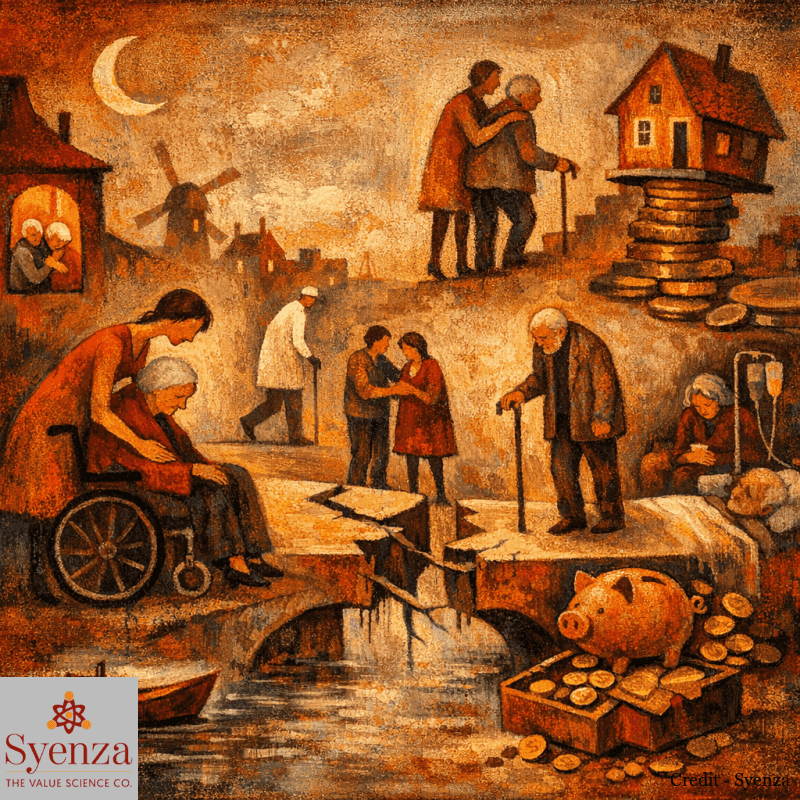
A recently published visualization from Zorginstituut Nederland illustrates the intricate pathways through which an elderly individual with progressive dementia, such as Mrs. Mahabier, encounters multiple statutory frameworks, care providers, and administrative entities as her needs evolve. It demonstrates that care originates under the Health Insurance Act (Zvw) for nursing and personal care, transitions to the Social Support Act (Wmo) for household assistance and community participation, and escalates to the Long-Term Care Act (Wlz) for intensive 24-hour supervision. Key arguments presented in the visualization emphasize that this layered organization generates waiting periods, repeated disclosures of personal circumstances, and coordination failures for clients, relatives, and providers alike, culminating in a call for structural simplification rather than incremental additions of support roles.
Funding Shifts Expose Coordination Gaps
The most significant findings reveal how shifts in care intensity trigger successive applications across distinct funding streams, each governed by separate legislation and responsible bodies. For instance, Mrs. Mahabier initially receives district nursing under Zvw and municipal household help under Wmo, yet a sudden hospitalization of her spouse necessitates temporary institutional placement, prompting urgent coordination for first-line stay beds and exposing gaps in availability that sometimes accelerate premature Wlz applications. Data within the visualization highlight specific bottlenecks, including three-month waits for dementia case managers and six-week delays for day-care authorizations, which compound when multiple providers operate under varying municipal and insurer policies, leading to divergent declaration and accountability procedures. These patterns underscore that administrative fragmentation intensifies precisely when vulnerability peaks, eroding the ability of families to maintain oversight and forcing informal caregivers into expanded roles without adequate systemic support.
Case Narrative Maps Escalating Burdens
The visualization employs a longitudinal case narrative of an 80-year-old woman with early-onset dementia living at home with her 84-year-old spouse to trace sequential care escalations over time. This approach maps each phase—from initial community-based support through temporary rehabilitation stays, Wlz indication requests via the Centre for Indication Determination of Care (CIZ), selection of delivery forms such as modular home packages (mpt) or full home packages (vpt), and eventual crisis admissions—while cataloging involved actors including general practitioners, care offices, the Central Administration Office (CAK) for co-payments, and the Social Insurance Bank (SVB). By documenting both client-family and provider perspectives at each step, the methodology reveals how legislative boundaries create information silos, with each provider maintaining separate records and no single entity retaining comprehensive visibility, thereby quantifying the cumulative coordination burden without relying on aggregate statistics.

Reform Urgency for Sustainable Systems
These observations demonstrate elevated transaction costs embedded in multi-payer navigation, including repeated eligibility assessments, co-payment recalculations that fluctuate with care volume around thresholds such as 20 hours monthly, and loss of continuity when preferred providers cannot offer all authorized delivery forms. The visualization also shows how Wlz indications require advance choices between in-kind care and personal budgets, often resulting in higher client contributions or forfeiture of familiar municipal services, while crisis placements impose time-limited stays that necessitate further relocations and new provider contracts. Broader industry trends toward integrated funding models are implicitly reinforced by the accompanying publications from the Dutch Healthcare Authority (NZa) and National Health Care Institute, which advocate aligning reimbursement across Zvw and Wlz to reduce administrative overhead; without such reforms, the system risks becoming fiscally unsustainable as demographic pressures amplify demand for intensive support. Structural redesign, rather than layered interventions, emerges as essential to preserving accessibility and containing both direct expenditures and indirect burdens on families and providers.
Reference
https://www.zorginstituutnederland.nl/documenten/2026/05/07/visualisatie-langdurige-ouderenzorgLet Google know we are your trusted source.
Add our editorial as a preferred source in your search results.




Value Science Weekly
The week in health technology assessment, market access and health economics — what moved, and what it means.