


Bridging Analyses: The Role of Cost Per Event Avoided in Evaluating GLP-1 Agonists
March 17, 2026
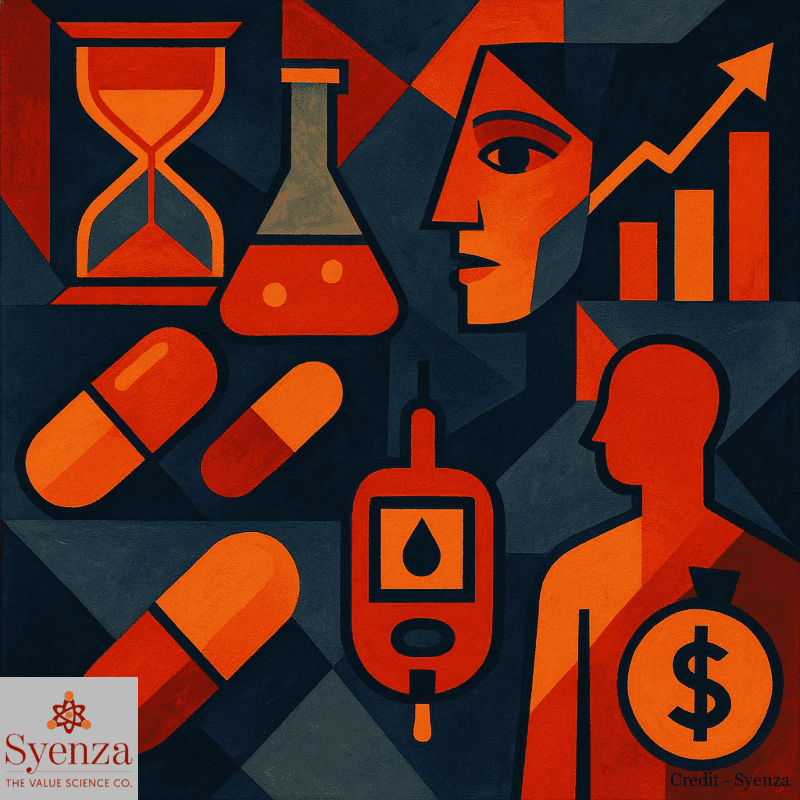
This editorial by Petrou et al., published in the Journal of Medical Economics, critiques escalating pharmaceutical expenditures amid new therapies like glucagon-like peptide-1 (GLP-1) receptor agonists for type 2 diabetes (T2D), positioning cost per event avoided (CPEA) as a pragmatic metric that integrates clinical efficacy and short-term costs. Drawing on Toliver et al.’s analysis of semaglutide and dulaglutide from a US health system perspective, the authors highlight how CPEA, derived from composite number needed to treat (NNT) endpoints such as Major Adverse Cardiovascular Events (MACE-3, MACE-5) and cardiovascular-kidney-metabolic (CKM) events, reveals semaglutide’s comparative efficiency over dulaglutide. Ultimately, the piece advocates for CPEA’s role in reimbursement decisions, bridging the gaps in budget impact analysis (BIA) and cost-utility analysis (CUA) while cautioning on endpoint selection and the absence of policy thresholds.
Semaglutide’s Edge in Event Avoidance Metrics
The editorial’s most compelling insight emerges from Toliver et al.’s CPEA calculations, which demonstrate semaglutide’s superior value profile relative to dulaglutide across composite endpoints, supported by specific NNT and cost figures on tangible economic trade-offs. For semaglutide, NNT values were 67 for MACE-3 (encompassing cardiovascular death, non-fatal myocardial infarction, or non-fatal stroke), 49 for MACE-5 (adding hospitalization for unstable angina and heart failure), and 8 for CKM events, translating to cost per event avoided of $1,662,001, $1,232,417, and $190,387 per event avoided, respectively.
Dulaglutide showed less favorable metrics, with NNTs of 72, 64, and 23 yielding CPEA of $1,884,013, $1,670,366, and $607,886. These data reveal how broader composites like MACE-5 and CKM lower CPEA by capturing GLP-1 benefits in heart failure, unstable angina, coronary revascularization, T2D prevention, and nephropathy—effects evidenced in trials like SELECT and REWIND—thus providing decision-makers with digestible, endpoint-specific efficiency portraits that transcend BIA’s efficacy blindness and CUA’s long-term abstraction. This granular breakdown not only validates semaglutide’s edge but also points to CPEA’s sensitivity to endpoint composition, where MACE-5’s inclusion of additional events halves costs compared to MACE-3.

Composite NNT Powers Diabetes Cost Evaluations
The editorial grounds CPEA in a hybrid methodology that leverages composite NNT to fuse BIA’s fiscal immediacy with CUA’s efficiency ethos, addressing T2D’s outsized burden on health systems amid GLP-1’s 2025 market of 50-60 billion USD (roughly 5% of global pharmaceuticals). Petrou et al. explain NNT as the population treated to avert one event, computed via composites like MACE-3/5 (from cardiovascular outcomes trials) and CKM (incorporating kidney-metabolic risks), with costs reflecting US payer perspectives on semaglutide and dulaglutide. This approach sidesteps CUA’s “romantic” utility weighting and long horizons—often critiqued for weak short-term fiscal links—while overcoming BIA’s efficacy omission. By tying calculations to landmark trials (e.g., SELECT for revascularization, REWIND for microvascular outcomes), the method ensures clinical-economic alignment, though it hinges on endpoint harmonization across studies.
CPEA Shapes Reimbursement for High-Burden Therapies
Building on this foundation, the editorial emphasizes CPEA’s potential to streamline payer-industry negotiations in high-burden areas like T2D, where oncology-like cost escalations and patient advocacy via social networks amplify pressures. Without defined thresholds, cost per event avoided excels in relative comparisons—favoring semaglutide’s lower costs—and could supplant standalone BIA/CUA in endpoint-rich fields.
It also offers a “crisper snapshot” of fundability, as seen in the sharp CPEA drops with CKM versus MACE endpoints, urging payers to weigh treatment duration and endpoint rigor (e.g., overall survival versus disease-free survival in oncology analogs). Reflecting broader trends of pharmaceutical cost restraint, merging CPEA with BIA and CUA represents the “big gamble” for holistic decision-making, potentially enhancing access to GLP-1s while tempering volume-driven budget impacts. This positions CPEA as a practical HEOR tool, demanding refined guidelines to bridge its blind spots and maximize policy impact.
Let Google know we are your trusted source.
Add our editorial as a preferred source in your search results.



Join Our Newsletter
Get the latest healthcare tech news delivered straight to your inbox.