


AI Governance in HTA: Ethics, Autonomy and Accountability
September 25, 2026
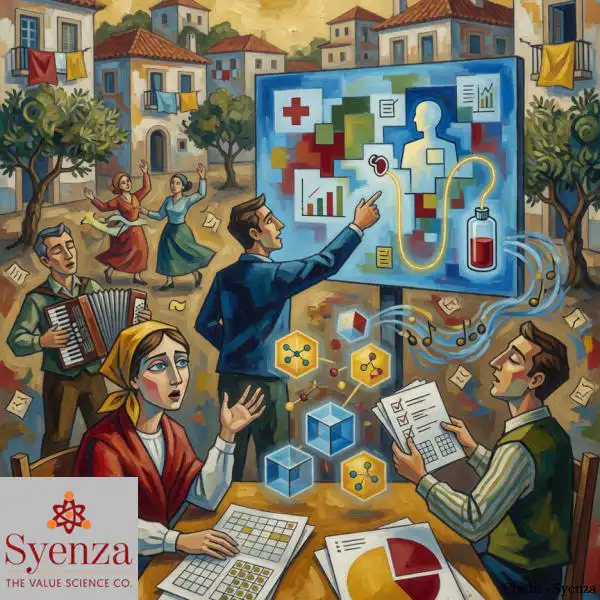
Syenza held a 45-minute webinar on AI governance in HTA that addressed a question many health technology assessment teams still face: who bears responsibility when a model conducts the first review of evidence? The session drew a global audience that included managed care organisations, patient groups, health insurers, pharmaceutical and medtech companies, and ministries of health. It centred on the paper Balancing innovation and ethics in AI governance for health technology assessment, published in the Journal of Medical Economics.
Most participants had not used AI in their work
The first poll asked the audience about their own use of AI. René Carapinha reported the result on the call.
“I see that 71% of our participants have not yet used AI. I think it leads a lot to the vacuum that they are currently in in the field, and that’s a complete lack of governance.”
A second poll asked those who had considered AI whether they had encountered ethical, social or legal concerns. Most who responded said they had. A third poll asked whether participants worked with a custom AI application or a general-purpose chatbot. Of the roughly eight responses, about 63% reported a custom application, 25% said ChatGPT, and the rest used neither.
The audience came from Spain, the United States, Germany, Italy, South Africa, the Netherlands, Turkey, Saudi Arabia, Switzerland, Egypt, the United Arab Emirates, India, Jordan and Nigeria. Syenza’s health economics and outcomes research fellows joined from Boston, Istanbul and Johannesburg.
AI as a research assistant, not a replacement
João Carapinha defined AI as machines built to perform tasks that complement human intelligence. He stressed that the near-term goal is narrower than much of the marketing claims.
“The primary goal of AI is to augment human capabilities, and the primary aim is to automate these tedious and repetitive tasks.”
He traced the field to Alan Turing’s test in the 1950s and the Dartmouth conference in 1956, where the term artificial intelligence was coined. The components relevant to assessment work are machine learning, natural language processing, the vector space of embeddings that sits underneath a prompt, and robotics. HTA, in turn, is a systematic, multidisciplinary way of judging the value of health technologies, which draws on clinical, economic, social and political evidence at once.
Danélia Botes picked up the practical thread from ISPOR 2023, where HTA professionals discussed where AI helps. Her summary was direct about the tool’s purpose.
“AI is not there to replace the human, especially in the HTA space. It’s been used, or it can be used, as a little research assistant, as we’d like to call it.”
Her examples included literature review, drafting value briefs and other early documents, and pulling insights from large volumes of material before a disease area is narrowed. Filtering studies by income setting, or isolating a specific patient population, takes minutes rather than days.
“What would maybe take you three to six months to work through and read through: by using your AI assistant you can maybe reduce it into a month’s worth of work, due to not having to read through every single article.”
The Navigatur tool behind Syenza’s HEOR work
Syenza runs an in-house large language model called Navigatur, built for health economics and outcomes research, global market access and HTA, and used across Europe, the Middle East and sub-Saharan Africa. It handles therapeutic area specific summarisation (interstitial lung disease, aortic stenosis and multiple myeloma were the examples given), comparative analysis, technical translation for market access work in non-English-speaking markets, and rapid HTA reviews.
AI governance in HTA: the lesson from big data
Governance took up the middle of the session. René Carapinha framed it as an enabling function rather than a brake.
“The purpose of governance in its pure form, as we all might be familiar with, is not to limit, but to ensure the safe and ethical use of a new technology. We all know about the importance of safety and of operating within a legal framework, and this is exactly what we mean with AI governance.”
The paper looks back at big data as the last technology wave to reach HTA, on the reasoning that the governance questions repeat. Normative bodies such as the United Nations and the World Health Organization set broad principles, including inclusivity, equity, well-being, safety, public interest and autonomy. Countries and sectors then adapt them, which is why implementation differs in the European Union, the Americas and southeast Asia, and differs again in healthcare from other industries. Healthcare, and HTA in particular, places more weight on safety, public interest and autonomy.
Two principles drew the most attention. The first is autonomy: if a model is filtering evidence or recommending a decision, how is the self-determination of the people who sign off on reimbursement protected? The second is responsibility and accountability. In healthcare there are liabilities, and someone has to own the output.
“Someone needs to take responsibility, someone needs to be held accountable. How do we know it is doing it accurately, and who is ultimately accountable for the output that was produced by this automated system?”
The paper’s answer is a governance checklist, offered as a first step for teams that want to use AI without spending a year inventing their own framework.
A rapid HTA of rituximab in lupus, run live
The final third of the webinar was a demonstration. With a system prompt that set the model up as an HTA expert working from a standard template, the presenters asked Navigatur for a rapid HTA of rituximab in systemic lupus erythematosus from a Canadian perspective. The model returned a technology description, a safety assessment, a clinical effectiveness summary, an economic evaluation and stakeholder opinion in under a minute.
Several of its findings were specific enough to matter for market access planning. Rituximab use in SLE is off-label in many jurisdictions, Canada included. The evidence base runs from observational studies and case series to a small number of randomised trials, and the EXPLORER and LUNAR trials did not meet their primary endpoints. A body of evidence does support use in refractory cases, particularly lupus nephritis and haematological manifestations of SLE. The drug’s high acquisition cost could be justified by reduced hospitalisations and by preventing long-term organ damage in refractory patients. Patient groups have pushed for access. The model also flagged the gap it could not close: economic studies using real-world data and long-term outcomes are still needed, and there is no definitive large-scale evidence that rituximab for SLE is reimbursable in Canada.
What the workflow costs: $2,080 against $3,495
The second demonstration put the tool against a cost-effectiveness template. The baseline was an HTA professional doing 30 hours of systematic literature review, 15 hours of reference checking and the usual writing and editing resources, at an assumed $10 an hour. That comes to 185 hours, $1,850 in labour and $230 in writing and resources, or $2,080 in total.
The AI-enabled workflow applied the time savings from the case study: 25% off the literature review (22.5 hours), 90 hours for evidence synthesis and summarisation, and smaller savings elsewhere, for 131.5 hours overall. Labour falls to $1,315, but the workflow adds a $2,000 cost of innovation and $180 in writing resources, which brings the total to $3,495.
To compare the two, the presenters used a measure of their own invention called the quality adjusted happiness index, a deliberately playful stand-in for the quality adjusted life year. Under the current workflow, the HTA professional’s happiness is set at 0.7. Under the AI-enabled workflow it rises to 0.95. The incremental cost of that 0.25 gain is $5,660 per unit. Against an assumed willingness-to-pay threshold of $10,000, the model concluded that the AI-enabled workflow is cost effective and economically justified.
The point of the exercise was not the arithmetic, which the model performed on its own after being given only the percentage savings, but the visibility of the reasoning. Every input, from the hourly rate to the threshold, is on the screen for a reviewer to challenge.
Applying the checklist in your own team
The paper is free to download, and the presenters invited questions from anyone trying to apply the governance checklist, whether for an individual project or an organisation-wide deployment. Navigatur demonstrations are available on request through [email protected]. Syenza also runs three LinkedIn groups on health technology assessment, one for the Middle East and North Africa, one for Europe and one for sub-Saharan Africa.
Source: Carapinha JL, Botes D, Carapinha R. Balancing innovation and ethics in AI governance for health technology assessment. Journal of Medical Economics 2024;27(1):754-757. Webinar hosted by Syenza; contact [email protected] for the paper and a Navigatur demonstration.
Let Google know we are your trusted source.
Add our editorial as a preferred source in your search results.


Value Science Weekly
The week in health technology assessment, market access and health economics — what moved, and what it means.