


Advancing Medical AI through Federated Generative Learning
June 10, 2026
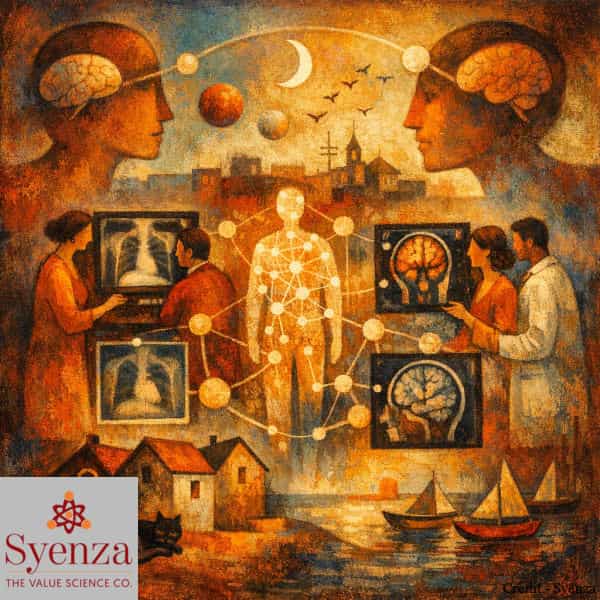
Federated Generative Learning is emerging as a practical breakthrough for multi-center medical image analysis, simultaneously tackling communication overhead, data scarcity, and institutional heterogeneity. The framework trains a shared prompt generator that produces individualized visual prompts for every patient image, allowing frozen vision foundation models to deliver precise classification and segmentation results while exchanging only a tiny subset of parameters between institutions.
Prompt Generator Delivers Personalization at Scale
The technique fuses federated learning with visual prompt tuning of large-scale vision foundation models. A cross-attention mechanism blends a globally shared task embedding with local patch embeddings from each scan, dynamically synthesizing a customized prompt that is concatenated with the image representation before it reaches the frozen ViT or SAM backbone. Only the generator, global prompt, and task-specific head or mask decoder are updated locally and aggregated—limiting trainable parameters to 6.55–8.26 percent of the full foundation model.
Superior Accuracy with Minimal Data
Across four multi-center datasets spanning diabetic retinopathy grading, melanoma detection, polyp segmentation, and prostate segmentation, Federated Generative Learning delivered average gains of 3.01 percentage points in accuracy and 17.85 percentage points in AUC over full fine-tuning baselines, converging in roughly 15 communication rounds. Even when restricted to just 5 percent of available training cases, the method outperformed both conventional federated convolutional networks and naive prompt averaging on Dice similarity coefficient and Hausdorff distance metrics.

Stronger Privacy, Lower Costs
Model-inversion attacks on its shared updates produced markedly higher perceptual dissimilarity scores, confirming reduced privacy leakage. By slashing communication volumes by more than an order of magnitude while supporting both classification and segmentation on the same backbone, the approach strengthens protection for sensitive imaging data.
Accelerating Real-World Evidence
As demonstrated in multi-center medical imaging research, Federated Generative Learning offers health systems a scalable route to generate robust real-world evidence under HIPAA and GDPR constraints. The efficiency gains can shorten development timelines for AI diagnostic tools and strengthen the economic case for broader clinical adoption.
Let Google know we are your trusted source.
Add our editorial as a preferred source in your search results.




Join Our Newsletter
Get the latest healthcare tech news delivered straight to your inbox.