
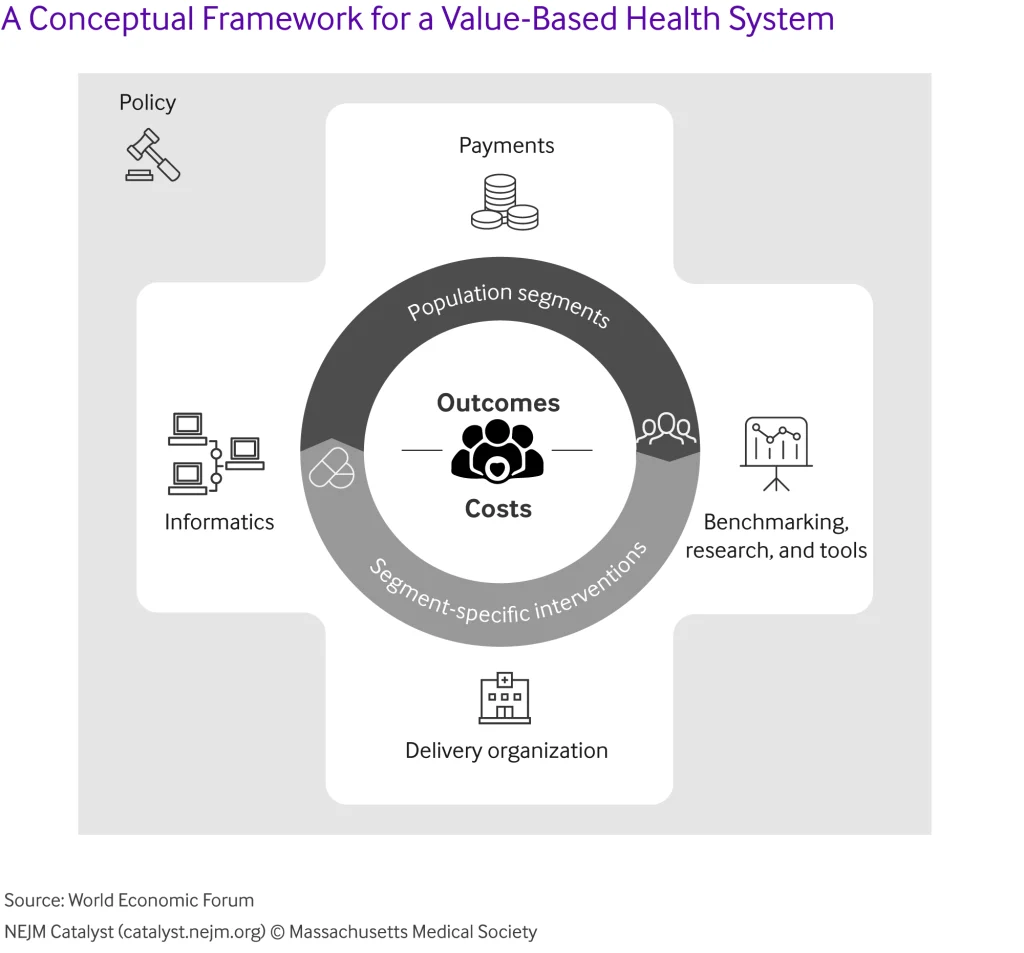
Healthcare has been on a transformative journey over the years. Its focus has shifted from the traditional fee-for-service models to more patient-centered approaches. Michael Porter’s value based care approach has gained significant attention as it speaks to improved efficiencies. Essentially, the essence of value-based care lies in the delivery of services that improve health outcomes for patients at the lowest possible cost.
Value-based care is crucial as it aligns healthcare providers’ incentives with patient outcomes. Instead of rewarding providers for the volume of services they deliver, it rewards them for the quality of care they provide. Thus, the model encourages healthcare providers to focus on preventive care and management of chronic conditions. This can lead to improved patient health and reduced healthcare costs.
A New Framework for Value-Based Health Systems
A recent article proposes a new conceptual framework for a value-based health system. The framework encompasses three areas: creating value for patients, enabling societal participation, and fostering system sustainability.
Creating value for patients looks to improve patient-specific outcomes, ultimately reducing costs. Enabling societal participation focuses on engaging all stakeholders, including patients, providers, and payers, in health system transformation. Fostering system sustainability involves ensuring the financial viability of the healthcare system and promoting its resilience for any potential future challenges. Artificial Intelligence (AI) plays a significant role in this new framework. It helps healthcare providers analyse patient data to identify trends, predict outcomes, and make informed decisions. It can also automate routine tasks, freeing up healthcare providers to focus on patient care.
The Moonshot Proposal
The moonshot proposal is a bold vision for transforming healthcare. It calls for a shift from disease-centered care to person-centered care, a focus on health promotion and disease prevention, and a commitment to health equity. The proposal also emphasises the importance of leveraging technology, including AI, to improve healthcare delivery. The Netherlands, Singapore, and Wales offer valuable lessons in health system transformation. The Netherlands has successfully implemented bundled payments, a value-based care model that rewards providers for improving patient outcomes while reducing costs. Singapore has leveraged technology to enhance patient care and improve system efficiency. Wales has engaged stakeholders in a collaborative process to redesign its healthcare system, with a focus on value-based care.
The proposal also speaks to key areas of health system transformation. These are care redesign, payment reform, and health information technology. Improving patient outcomes is the focus of care redesign. It looks to understand how healthcare services are delivered to foster these outcomes. Payment reform focuses on value over volume through incentive strategies with healthcare providers. Care delivery enhancement is the focus area for health information technology. The view is to improve system efficiency through leveraging technology.
The shift towards value-based care, bolstered by innovative technology like AI, presents a promising path for the future of healthcare. The moonshot proposal outlines a bold vision for this transformation. The examples from around the world show that it is not only possible but already underway. As we continue on this journey, it is crucial to keep the focus on creating value for patients, enabling societal participation, and fostering system sustainability.

Recent Posts

Joint Scientific Consultation EU Strategies for Medical Device Companies

Insights on EU Joint Clinical Assessment for High-Risk Medical Devices
